
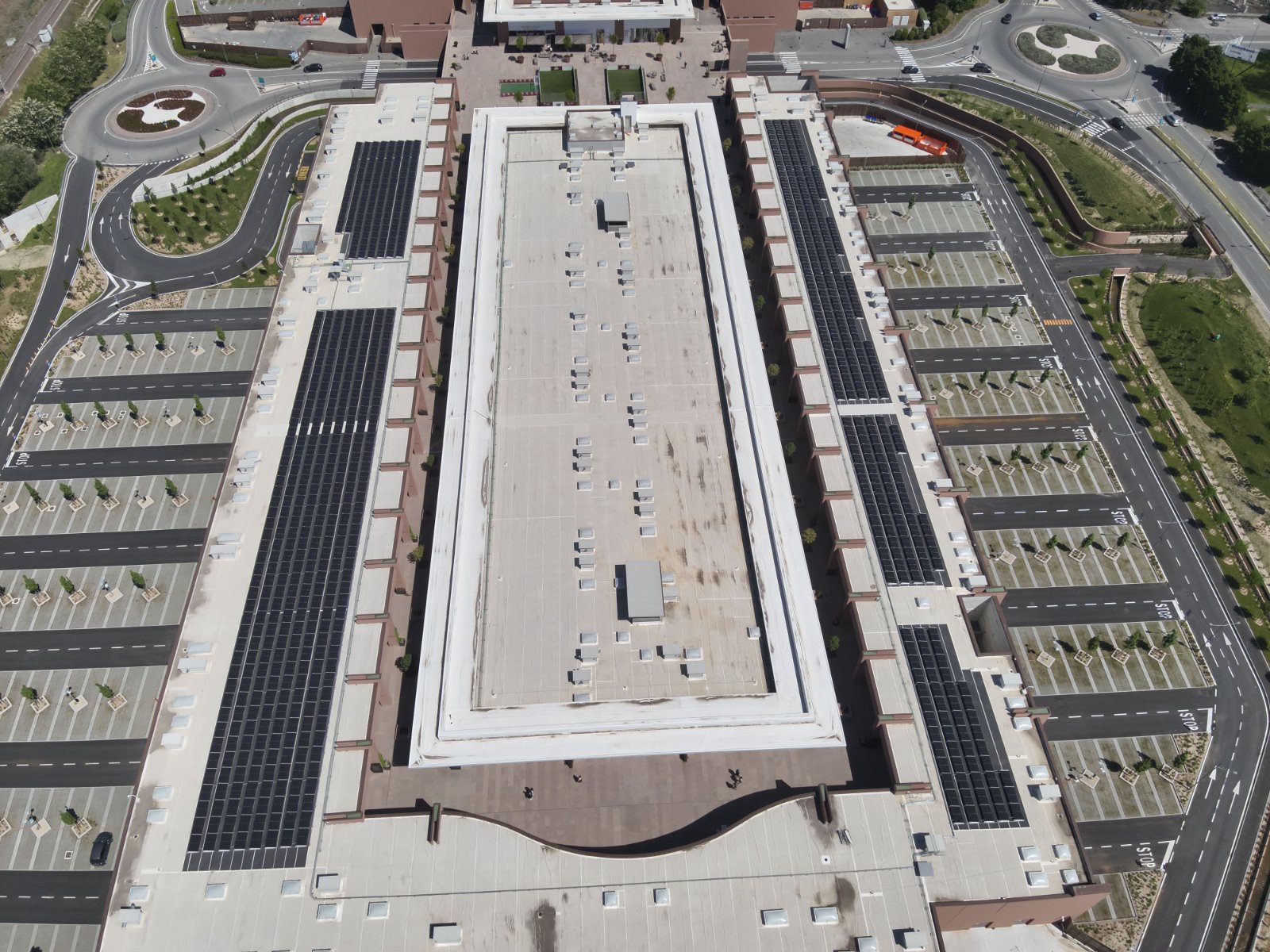
The project, developed in the Village’s most recent expansion area, enables the renewable energy produced on site to be virtually shared with the first phase of the outlet. The system is expected to reach an overall self-consumption rate of 93% and avoid approximately 113 tonnes of CO₂ emissions per year.
Turin, 1 July 2026 — Torino Outlet Village, one of Northern Italy’s leading shopping destinations, and Helexia, a key player in the energy transition specialising in renewable energy production and energy efficiency solutions, announce the completion of a new photovoltaic project designed to combine innovation, energy efficiency and environmental sustainability.
The initiative represents a further step in the ongoing evolution of Torino Outlet Village, which has progressively expanded its retail offer and visitor services over the years, while placing increasing focus on innovation and sustainability as strategic pillars of site management.
Today, Torino Outlet Village covers a total area of 32,000 m², with around 140 boutiques, more than 3,500 free parking spaces and a strategic location just 10 minutes from the centre of Turin and 50 minutes from West Milan. The Village has established itself as a reference hub for shopping tourism and for an experience that brings together retail, hospitality, culture and entertainment.
From regulatory requirement to strategic opportunity
The photovoltaic project was initially developed in response to regulatory requirements for the integration of renewable energy sources in new buildings, specifically within the Village’s most recent expansion area.
However, Torino Outlet Village chose to go beyond compliance. The project became an opportunity to optimise energy consumption on a broader scale, generate long-term economic benefits and further strengthen the Village’s ESG roadmap.
Why Helexia
Torino Outlet Village selected Helexia for its ability to provide an integrated solution combining technical expertise, regulatory knowledge and a flexible financial model.
A key factor was Helexia’s capacity to design a project that went beyond the installation of a photovoltaic plant. The solution was structured to maximise the value of the energy generated through an innovative remote individual self-consumption model, allowing the renewable energy produced in one area of the site to support energy needs in another.
“The project developed with Torino Outlet Village shows how a tailor-made technical solution can transform a regulatory requirement into a concrete strategic opportunity. Our approach combines technical expertise, innovative energy models and a flexible financial structure, enabling us to develop effective and sustainable solutions for our clients. Our goal is to support companies through personalised energy transition pathways that combine environmental sustainability, operational efficiency and ease of implementation.”
— Giovanna Licata, Country Director, Helexia Italy
The solution implemented
The project involved the installation of a 385.65 kWp photovoltaic plant in the Village’s most recent expansion area.
Thanks to the selected configuration, the energy generated is first used to cover local consumption. Any surplus energy can then be virtually allocated to the consumption of the Village’s original area through the electricity distribution network, in line with the requirements of current regulations.
In this way, the different areas of Torino Outlet Village operate as a single energy ecosystem, maximising the use of renewable energy produced on site.
“With this project, we wanted to transform a regulatory requirement into a real opportunity for innovation. The introduction of remote self-consumption has allowed us to connect the different areas of the Village, optimise the use of the energy produced and strengthen our sustainability journey with measurable environmental and economic benefits.”
— Luca Frigeri, Director, Torino Outlet Village
Remote self-consumption as a driver of efficiency
One of the main challenges addressed by the project was the distribution of energy consumption across the different areas of the complex. Since the photovoltaic plant was installed in only one part of the site, a significant share of the energy produced could have remained unused locally.
The remote self-consumption model made it possible to overcome this limitation by valorising surplus energy and making it available to another area of the Village. This improves the overall efficiency of the system and reduces the amount of renewable energy that would otherwise not be fully used on site.
Shared energy, measurable results
The project is expected to deliver significant performance results. Estimated annual production is approximately 448.7 MWh, while total self-consumption is expected to reach around 416.4 MWh, corresponding to an overall self-consumption rate of 93%.
Of this total, more than 100 MWh is expected to come from energy shared between the two areas of the Village, representing around 23% of total self-consumption.
These figures confirm the effectiveness of the model adopted in minimising unvalorised surplus energy and improving the balance between production and consumption across the site.
The environmental impact is also significant. According to estimates, the plant will avoid approximately 113 tonnes of CO₂ emissions each year, equivalent to planting more than 2,200 trees or covering the average annual energy needs of around 168 households.
A clear and predictable operating model
From an economic perspective, the project was developed through an operating lease model. Helexia managed the different stages of the project, from design and construction to operation and maintenance of the plant.
This approach enables Torino Outlet Village to access the energy and economic benefits of the project through a clear, predictable model over time, while maximising the value of the energy produced and shared.
Part of the Village’s broader ESG roadmap
The photovoltaic project forms part of a wider sustainability journey at Torino Outlet Village, which also includes services and infrastructure supporting more sustainable mobility, such as electric vehicle charging stations available on site.
In this context, photovoltaics is not a final destination, but a concrete step in a continuous improvement process aimed at reducing environmental impact and increasing the energy resilience of the site.
Looking ahead, Torino Outlet Village intends to continue along this path, assessing potential further developments capable of extending the benefits of the project and strengthening the site’s overall efficiency, in line with a vision of sustainability as a continuous and progressive journey.
[/vc_column_text][/vc_column][/vc_row]